
CSRD: What Is It, Who Is in Scope, and When Does It Apply?
- elifcark
- 1 Şub
- 3 dakikada okunur
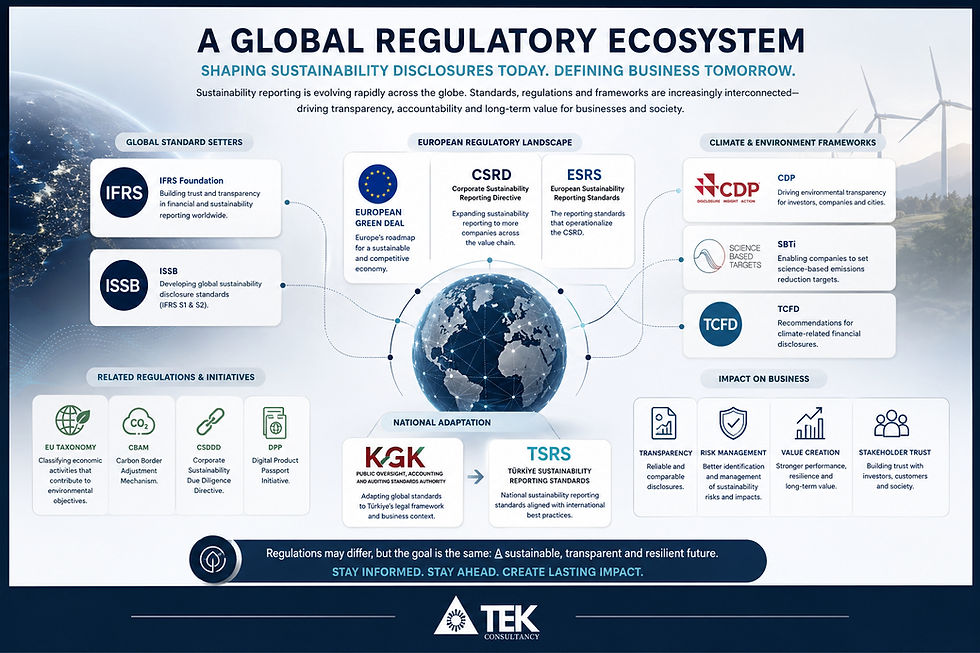
The Corporate Sustainability Reporting Directive (CSRD) is a European Union regulation that significantly expands and strengthens sustainability reporting requirements for companies operating in or connected to the EU. It marks a shift from voluntary or high-level disclosures to standardised, assured, and decision-useful sustainability reporting.
CSRD replaces the Non-Financial Reporting Directive (NFRD) and responds to growing expectations from investors, regulators, and stakeholders for transparent and comparable ESG information.

Objectives of the CSRD
Primary Goals:
Transparency and Consistency: Standardised reporting for easy access and understanding.
Reliable and Comparable Information: Integrates sustainability with fi nancial reports for comprehensive stakeholder insight.
Support EU Goals: Aligns with the European Green Deal and aims for climate neutrality by 2050.
Foster Sustainable Practices: Encourages integration of sustainability risks and opportunities into business strategies.
Mechanisms:
● Mandatory Reporting: Broad scope and depth of reporting requirements.
● Digitalization of Reporting: European Single Electronic Format (ESEF) ensures effi cient reporting and analysis.
● Assurance Requirement: Third-party assurance for reliability, evolving towards higher standards.
Scope of the CSRD
Coverage:
● Entities: All large companies, listed SMEs, and non-EU companies with signifi cant EU operations.
● Geographical and Sectoral Reach: Global impact, affecting companies across all sectors with signifi cant EU presence.
● Sustainability Information: Reports on ESG issues, impacts, risks, and opportunities related to business strategies.
Implementation Timeline:
● Phased Implementation: Starts in 2025 (based on FY 2024) for NFRD companies, with staggered timelines extending to 2029.
● Reporting Postponement: Two year postponement of reporting requirements for wave 2 and wave 3 companies.
What Is the Purpose of CSRD?
The main objective of CSRD is to improve the quality, scope, and reliability of sustainability information disclosed by companies. It aims to ensure that sustainability data is as robust and comparable as financial information.
Under CSRD, companies are required to disclose detailed information on:
Environmental, Social, and Governance (ESG) matters
Sustainability-related impacts, risks, and opportunities
How sustainability is integrated into strategy, governance, and business models

Which Companies Are in Scope of CSRD?

CSRD applies to the following categories of companies:
1. Companies Previously Covered by the NFRD
Public-interest entities that:
Employ more than 500 employees, and
Have either a balance sheet total above €25 million or net turnover above €50 million
2. Large Companies
Companies meeting at least two of the following criteria:
Balance sheet total > €25 million
Net turnover > €50 million
More than 250 employees
3. Listed Small and Medium-Sized Enterprises (SMEs)
Listed SMEs (excluding micro-enterprises) meeting at least two of:
More than 50 employees
Balance sheet total > €5 million
Net turnover > €10 million
4. Non-EU Companies
Non-EU companies with significant activity in the EU, defined as:
Net turnover above €150 million in the EU for two consecutive years, and
At least one of the following:
A large EU subsidiary
A listed EU subsidiary
An EU branch with net turnover exceeding €40 million
When Does CSRD Reporting Start?
CSRD will be implemented in phases, depending on company type:

Additional Phase-In Flexibility:
● First Year: Omission of anticipated fi nancial effects from climate and other environmental impacts allowed.
● First Three Years: Qualitative disclosures allowed if quantitative disclosures are impracticable.
● Small Entities: May omit data on GHG emissions, biodiversity, resource use, and social disclosures in fi rst two reporting years.
Implementation Guidance:
● Companies should prepare for full compliance, building robust systems for data collection and reporting.
![[TR] CBAM ile Küresel Ticarette Yeni Dönem](https://static.wixstatic.com/media/ea9162_5428c45ac304424f8b09f427727e07ba~mv2.webp/v1/fill/w_980,h_245,al_c,q_80,usm_0.66_1.00_0.01,enc_avif,quality_auto/ea9162_5428c45ac304424f8b09f427727e07ba~mv2.webp)

Yorumlar